|
Create New Account
Millard Lumber Newsletter
Register to receive newsletters and notices by email. Register Now
|
Vinyl Windows
In this document you will find information about:
- Vinyl replacement windows
- Features of vinyl windows
- Measuring vinyl windows
- Installing vinyl windows
|
|
|
 |
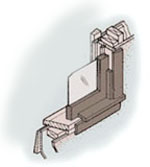
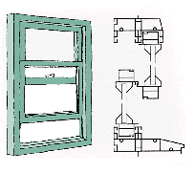
| FIG.
1 - Single- and double-hung vinyl windows are popular choices
for replacing old wood windows. They fit into the sash opening,
so they can be installed without removing the entire window. Although
vinyl itself is not a great insulator, vinyl window frames are nearly
as effective as wood, because the multiple chambers in the extrusion
(right) create dead air space that slow heat transfer. |
|
|
|
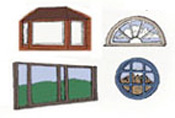
| FIG.
2 - Vinyl windows come in a variety of shapes and styles. |
|
|
VINYL REPLACEMENT WINDOW BASICS
- It wasn't too long ago that vinyl windows were considered
a less-than-ideal choice for replacement windows. But advances in
design plus improvements in the formulation of polyvinyl chloride
(PVC) have made vinyl windows a high-quality product that competes
favorably with wood.
- Vinyl windows have always had some advantages over
aluminum and steel. Metal is a highly efficient heat conductora
great property when it comes to pots and pans, but not so slick when
you're talking about window frames. As window glazing has improved,
the difference in insulating value between the glass and the frame
of a metal window became greater and greater.
- PVC, on the other hand, is a nonconductor of heat.
It doesn't truly insulate like wood, but the design of a vinyl window
adds greatly to the frame's insulating value. The primary reason that
insulating glass works is because there is a pocket of trapped air,
called dead air space, between the inner and outer panes. Vinyl window
frames work on the same principle. The frames are hollow, built with
multiple chambers to add strength (Fig. 1). Those chambers also trap
air and thereby slow heat transfer.
- Good quality vinyl windows are nearly equal to wood
windows in their overall insulating value, but not just because of
the frames. Compared to old shop-built wood double-hung windows, the
factory weather-stripping in modern vinyl windows allows only a fraction
of the air leakage around the sash. As a rule, air infiltration is
even more important than insulating quality in preventing heat loss.
- Vinyl windows come in a variety of styles, including
single- and double-hung (Fig. 1), horizontal sliding (Fig. 2), casement,
awning and hopper. Sliding patio doors are also available. The color
is part of the PVC formula, so vinyl windows never have to be painted.
Most come in white and almond, some with wood grain overlays inside.
- Vinyl windows offer the same style features found
on other top-quality windowsdivided light grids, decorative
glass, tilt-out sash on single- and double-hung units, high-efficiency
locking systems, premium configurations such as circle tops, bay and
bow units and even brass hardware. Like all vinyl products, they are
also maintenance-free.
- A few manufacturers still make dark brown windows,
but many have stopped manufacturing dark colors. Despite advances
in formulation, vinyl is still more sensitive to temperature variations
than other window materials, and dark colors absorb heat more readily
than light colors.
|
|
 |
|
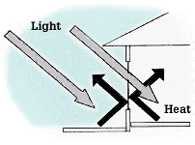
FIG.
3 - Low-E glass works by allowing visible light to pass through
the glass, but reflecting
infrared rays (heat). Modern vinyl replacement
windows are available with the latest advances in glass technology.
From the Estimator's Encyclopedia,
© 1993, Greg Brooks Communications
|
|
|

FEATURES OF VINYL WINDOWS
- There are differences in the quality of vinyl windows just as there
are in any building product. Some of the features that distinguish different
windows include:
- Vinyl formulation. Early vinyl windows had problems with extreme expansion
and contraction during temperature swings, as well as fading, peeling
and cracking when exposed to direct sunlight. Manufacturers have switched
to PVC without plasticizers (called UPVC) to minimize movement and developed
additives that help resist the ultraviolet rays in sunlight.
- Frame design. Vinyl window frames may be
screwed together like aluminum windows, or welded at the corners. Windows
with welded frames tend to be sturdier, as well as more energy efficient,
since air is sealed inside.
- Glazing. Modern vinyl windows are available with the
same high-tech glazing used in top-of-the-line wood windowsinsulating
glass with low emissivity (low E) coatings (Fig. 3), and filled with
argon gas to increase insulating value.
- Many states have adopted an energy efficiency rating system for windows
developed by the National Fenestration Ratings Council (NFRC). The NFRC
rating lists the U-value for the overall window, not just the glass.
The lower the U-value, the more energy efficient the window.
- If your house has older wood double-hung windows, vinyl is a good
replacement choice and a reasonably easy do-it-yourself project. You
don't have to remove your old windows entirely, because vinyl replacement
windows are made to fit in the sash opening.
|
|
|
 |
|
FIG.
4 - To measure a traditional double-hung window for the width
of a vinyl replacement window (left), take the measurement from
jamb to jamb in three placesat the top of the opening, in
the middle and at the bottom. If there is a variation, use the smallest
dimension.
To
measure the height of a vinyl replacement window (right), take the
measurement from the sill to the head jamb. Measure on both sides
of the window.
|
|
|

MEASURING VINYL WINDOWS
- The most important part of the installation procedure comes before
you even have your windows. It is critical that you measure your old
window opening properly and accurately (Fig. 4).
- Vinyl windows are custom-built and can't be returned if they don't
fit. Most are manufactured in 1/4" increments, and you'll want to get
the closest fit possible.
- Manufacturers' measuring instructions vary, but the following procedures
are typical.
- To measure the width, raise the lower sash and measure the jamb-to-jamb
width in three placesnear the top of the window, at the middle
and close to the bottom.
- To measure the height, measure from the
head jamb to the sloped sill just past where it meets the inside window
stool.
- Don't assume that all your windows are the same size.
Draw a rough sketch of your house and number each window you plan to
replace, then measure each of them separately.
|
|
|
|
|
| FIG.
5 - Remove the inside and blind stops to remove the old sash
and install the replacement window. |
|
 |
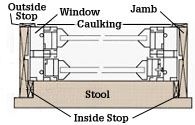
| FIG.
6 - Top ViewThe replacement window is held in place by
the outside stops on the outside and the inside stops and stool on
the inside. |
|
|
|
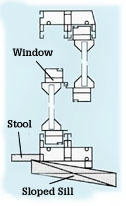
| FIG.
7 - Side ViewSome vinyl replacement windows are made to
rest directly on a sloped sill. |
|
|
|
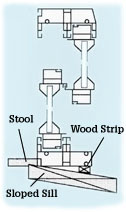
| FIG.
8 - Side ViewSome vinyl replacement windows have lower
extrusions that are flat; a wood strip can be used as a support. |
|
|

INSTALLING VINYL WINDOWS
- To install a vinyl replacement window, first remove
the old sash. A traditional double-hung window has two sets of removable
stops (Fig. 5). All have an inside stop that holds the lower (inner)
sash in place and a blind stop that separates the two sashes. The outside
stop is nailed to the edge of the sash and is not removable.
- Pry off the inside stops carefully so you can reuse them. Cut the
sash ropes and remove the lower sash, then pry out the blind stop and
remove it. Remove the upper sash.
- Set the replacement window in the opening. It should fit snugly between
the stool on the inside and the outside stops of the old window on the
outside (Fig. 6). If the new window is narrower, you may need to nail
a strip of wood to the jamb to fill the gap between the window and the
outside stop.
- Some vinyl replacement windows have sloped extrusions on the bottom
that match the sloped sill of your old window (Fig. 7); others are flat.
If the bottom of your new window is flat, you may be able to use a piece
of lattice or door stop as a support for the front edge of the window
(Fig. 8).
- If not, you'll have to rip an angled support. To do so, set the window
in place in the opening, and measure the gap between the front lower
edge of the window and the old sloped sill.
- You can make supports for all your windows at one time. Plane the
edge of a board at an angle that roughly matches the slope of the sill,
then rip a strip of wood to match the gap. To install the support strip,
cut it to length and nail it in place directly beneath the point where
the front edge of the new window will rest.
- Center the window in the opening. Use a carpenter's square to make
sure the window is square, then shim the sides of the window directly
behind the predrilled screw holes in the jamb. Screw the window in place
through the side jambs, then replace the inside stop.
- Go inside and check the window to make sure it operates properly.
Then go back outside and run a narrow bead of caulking all around the
window to seal the gap at the outside stop.
|
|
| Check your state
and local codes before starting any project. Follow all safety precautions.
Information in this brochure has been furnished by the National Retail Hardware
Association (NRHA) and associated contributors. Every effort has been made
to ensure accuracy and safety. Neither NRHA, any contributor nor the retailer
can be held responsible for damages or injuries resulting from the use of
the information in this document.
|
|