
|
Create New Account
Millard Lumber Newsletter
Register to receive newsletters and notices by email. Register Now
|
Designing a Home Security System
Making your home secure isn't a matter of buying certain productsit's
an overall strategy that combines locking the house tightly, eliminating the
ways that intruders can conceal themselves on your property, and giving the
appearance that you are home, whether you are or not.
 |
| FIG.
1 - Critical security areas in your house. |
Intruders aren't the only problem. Your home security strategy should also
involve preventing accidents on your property. Many of the same things you do
to protect your property from intruders are the same things you do to prevent
accidents and to make your home more convenient and comfortable.
Home security systems used to be wired in during new construction, and retrofitting
a system was an expensive job that could only be done by professionals. Today,
combination home automation/home security systems are available that are so
easy to install that they hardly qualify as do-it-yourself projects. This brochure
describes the procedures involved in setting up such a system as part of an
overall home security strategy.
The most important aspect of any security system is balanceit does no
good to make your windows burglarproof when your doors can be opened more easily
with a pry bar than with a key. Before you invest in an automated system, first
take stock of the simple, everyday security measures that should already be
in place.
|
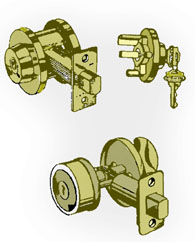
FIG.
2 - A double-cylinder
deadbolt (top) is operated with a key from both sides; a single-cylinder
deadbolt (bottom) has a key on the outside and a turn button inside. |
SECURING DOORS
- Every entry and utility door in the house should be
a solid dooreither stile-and-rail construction or a solid-core
flush door. As a rule, doors that swing into the house are more secure
than outswinging doors, both because the gap between the door and jamb
is not exposed and because the hinge pins are on the inside.
- If you have an outswinging door, make sure it has at
least one nonremovable pin hinge. You can tell by opening the door and
looking at the hinge pins. A nonremovable pin hinge has a set screw
in the pin that prevents the pin from being removed.
- All entry doors should also be fitted with deadbolts
(Fig. 2). There are two common types of deadboltssingle cylinder
and double cylinder. Single-cylinder deadbolts are operated with a key
from the outside and a turn button inside. Double-cylinder deadbolts
must be operated with a key from both sides.
- Sliding patio doors (Fig. 3) are notoriously easy
to break into. One of the first things a burglar looks for is a door
that is loosely fitted and wiggles a little, and sliding doors can't
be built to be totally tight.
- Modern patio doors often have
a three-point locking system that throws a hardened bolt up into the
head jamb and down into the sill to supplement the hook-type lock at
the handle. If you have an older patio door, one inexpensive alternative
is a hinged bar mounted on either the active door panel or the jamb
that swings down to wedge the door closed (Fig. 3).
|
|
|
FIG.
3 - Sliding
patio doors are one of the most vulnerable points in the house. They
can be secured inexpensively with a hinged bar that holds the operating
panel shut.
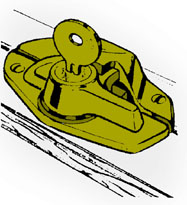
FIG.
4 - Sash
locks are an inexpensive way to improve the security of double-hung
windows.
|
SECURING WINDOWS
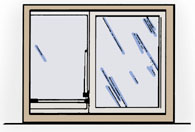
- The general rule of thumb is that all sliding windows
(both horizontal sliders and single- or double-hung) are more difficult
to secure than swinging casement or awning windows. Most modern swinging
windows have cam locks that draw the sash tightly into the frame.
- Obviously you want to make sure
all window locks operate properly, but you can add to the security of
sliding windows by installing key locks in place of the standard sash
locks (Fig. 4).
|
|
|
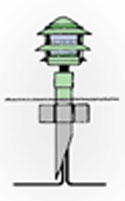
FIG. 5 - Low-voltage
lighting is easy to install and adds to the appearance of your home.
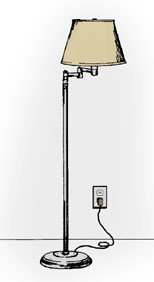
FIG. 6 - A lamp module
simply plugs into the existing outlet. The lamp is plugged into it,
and can be controlled remotely.
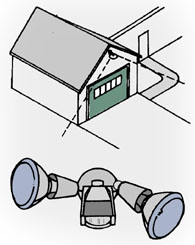
FIG. 7 - A motion-detector-controlled
floodlight can be set to varying sensitivity, so it ignores stray cats
but comes on when visitors--or burglars--enter the driveway.
|
LIGHTING
- Outdoor lighting (Fig. 5) is one of the best deterrents
availableas well as an important safety feature. Low-voltage lighting
kits can be installed in an afternoon, while adding to the appearance
of your home. Most operate from a transformer that can be plugged into
any standard electrical outlet, so no wiring is required. With the development
of more reliable solar cells and batteries, solar outdoor lighting is
now more dependable and even easier to install than the low voltage
lighting systems. On most of these types of lights, you mount them,
allow them to charge up and then turn them on. The only problem associated
with many of them is placing them in the wrong location so they don't
get enough light.
- Make sure, too, that the entire
area around your house can be well lighted. Install floodlights over the
driveway and at the back of the house; if you can position lights so
every door and window in the house is covered, you can scare away nearly
any burglar.
- Once you have the basics taken care of, then a home
security system may be a worthwhile investment. Modern systems operate
from your existing wiring. They allow you to operate incandescent lights
and appliances remotely, whether they are plugged into an outlet or
wired to a wall switch.
- The system consists of the following components:
- The controller sends signals to each remote module
individually or to all modules at once. Wireless controllers are also
available.
- Plug-in modules are plugged into standard electrical
outlets. Then the device is plugged into the module (Fig. 6). The lamp
module is designed for low-amperage use and includes a dimmer function.
The appliance module is designed for heavier amperage use such as televisions,
coffee makers and other small appliances.
- A wall-switch module replaces the standard wall switch
and allows the system to control any incandescent light wired into the
home's electrical system. Modules are available for both single-pole
and three-way switches.
- A motion detector can be programmed to turn on any
lamp plugged into a base module.
- A motion-detector-controlled floodlight can be programmed
to varying degrees of sensitivity and to turn off again a specified
amount of time after it comes on (Fig. 7).
- Setting up the system depends
somewhat on your individual needs, although there are some basic guidelines
you may want to follow. As a rule, the best way to deter burglars when
you're away is to make them think you're home. If your system allows
you to control eight modules, for example, consider the following locations:
- A front porch light or floodlights over the garage
door. These lights should be set to go on in the evening at dusk and
off again around 10 p.m.
- A main living room light. This light should be programmed
to go on in the early morning, say from 7 a.m. to 8 a.m., then off and
on again at 6 p.m. until about 10 p.m.
- A television. Your TV can be programmed to go on and
off at varying times during the day and evening; from outside, it can
sound like people conversing in the house.
- A kitchen light. It should be set to go on and off
again around common mealtimes.
- Bedroom lights. The lights in at least two bedrooms
could be programmed to come on in the morning, then off around 8 a.m.,
then on again in the evening.
- A stereo or radio. Set the radio to a talk station
and program it to go on and off at varying times.
- A bathroom light. Program it to go on, then off after
10 minutes or so, four or five times per day.
- A back porch light or floodlights. Program these to
be on whenever it is dark, until bedtime.
- To install modules in electrical outlets, simply plug
the module into the outlet, then plug the lamp or appliance into the
module.
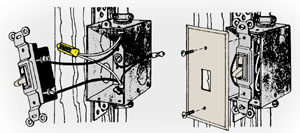
- To install wall-switch modules, you'll need to replace
the existing switch (Fig. 8). First, double-check the light by turning
it on. Then turn off the power to that circuit, and tape over the breaker
switch or fuse socket to prevent anyone from accidentally turning the
power back on while you're working. Try the switch again to make sure
the circuit is dead.
- Remove the switch-plate cover,
then unscrew the two screws that hold the switch in the electrical box.
Carefully pull the old switch out of the box and check the terminals
with an electrical tester to confirm that the circuit is dead.
- Unscrew the switch terminals and remove the old switch.
Attach the wires to the switch module, taking care to match the wires
to the same terminals. Carefully push the wires back into the box, then
screw the wall-switch module to the box. Replace the cover plate, then
turn on the circuit. Test the light to make sure it works properly.
 |
| FIG. 8 - When replacing
a wall switch, first turn off the circuit at the main breaker box.
Double-check by operating the switch. Then remove the cover plate,
unscrew the switch from the electrical box, and carefully pull the
switch out of the box. Triple-check the power by touching the ends
of an electrical tester to the switch terminals. If the power is off,
unhook the old switch and replace it with the wall-switch module.
Then push the switch back into the box, screw it in place, and replace
the cover plate. From the Sunset book, Basic Home Wiring
Illustrated, © Sunset Publishing Corporation. |
|
|
| Check your state
and local codes before starting any project. Follow all safety precautions.
Information in this document has been furnished by the National Retail Hardware
Association (NRHA) and associated contributors. Every effort has been made
to ensure accuracy and safety. Neither NRHA, any contributor nor the retailer
can be held responsible for damages or injuries resulting from the use of
the information in this document.
|
|
|