 |
 |
|
|
 Remodeling a
kitchen may include anything from repainting the walls to redesigning the entire structure
of the house. Space limitations prohibit covering every issue you might have to deal with,
but this document will cover the basic principles of design, as well as the general
considerations involved in planning a new kitchen.
Remodeling a
kitchen may include anything from repainting the walls to redesigning the entire structure
of the house. Space limitations prohibit covering every issue you might have to deal with,
but this document will cover the basic principles of design, as well as the general
considerations involved in planning a new kitchen.
The process of planning a kitchen is basically one of determining how you use your kitchen (the answer involves more than just "cooking") and what features you'd like, then deciding on your priorities so you can fit as many features as possible into your budget. Virtually anything can be done to a kitchen - walls can be moved, plumbing can be changed, and electrical service can be added. But the less you spend on major structural or mechanical work, the more money you'll have to put into better cabinets, higher-grade flooring and more stylish and functional fixtures.
The following list of questions will lead you through some of the issues you'll have to resolve before you're ready to design your new kitchen. There are no right or wrong answers - only your preferences. Carefully consider each question; make notes as you go, and don't be shy about changing your mind. A kitchen is the most complex and the most used workshop in the house, and it's important that your remodeled kitchen matches your needs and lifestyle as closely as possible.
 THE FIRST STEP IS TO CONSIDER HOW YOU USE
YOUR KITCHEN:
THE FIRST STEP IS TO CONSIDER HOW YOU USE
YOUR KITCHEN:
How many people are in your household who use the kitchen? The answer to this question will determine how much use your kitchen gets, and how much traffic there is likely to be in the kitchen at any one time.
This, obviously, is not a complete list of the general considerations in kitchen planning - the list is nearly infinite. But before you begin designing, think about who uses the kitchen and how they use it.
 Next, think about the features you want,
for example
Next, think about the features you want,
for example
The fewer structural and mechanical changes you make, the less you'll spend. But that doesn't mean that all those changes cost a lot of money. You'll need the advice of licensed professionals to make final decisions, but you can at least get a rough idea of how much extra major changes would cost by answering the following questions:
 The next step - and the most fun - is to
think about style. Chances are, you've seen kitchens that you like, in magazines, friends'
homes, etc. The first question to ask is whether the style you like best will fit with
your home. You may have loved European cabinets in the magazine, but they might not look
as good in your Queen Anne Victorian.
The next step - and the most fun - is to
think about style. Chances are, you've seen kitchens that you like, in magazines, friends'
homes, etc. The first question to ask is whether the style you like best will fit with
your home. You may have loved European cabinets in the magazine, but they might not look
as good in your Queen Anne Victorian.
Also, consider what kind of color changes you'd like to make - and whether your ideal
colors would necessitate buying new appliances. When you choose colors, think of them in
relation to surrounding rooms and try to find colors that complement the rest of the
house. 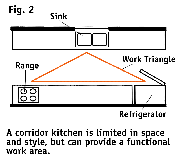
Finally, consider your budget and any other remodeling that you might want to do. Sometimes, related projects are easier and cheaper when done at the same time as the kitchen.
 Most kitchens are designed around four
work centers:
Most kitchens are designed around four
work centers:
If space permits, some designers also include a serving center - another 36" to
84" of free counter space to set bowls and pans.
As you design, you'll also want to plan for the following minimum clearances so you'll have room to work:
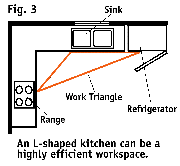
 Kitchen layouts are based on a concept
called the work triangle. The work triangle consists of imaginary lines that connect the
refrigerator, the range and the sink. For maximum comfort and efficiency, the three legs
of the work triangle should total between 23 and 26 feet.
Kitchen layouts are based on a concept
called the work triangle. The work triangle consists of imaginary lines that connect the
refrigerator, the range and the sink. For maximum comfort and efficiency, the three legs
of the work triangle should total between 23 and 26 feet.
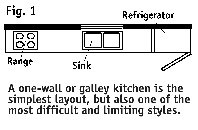
There are four basic kitchen layouts (Figs. 1-4) the one-wall or galley, the corridor,
the L-shaped and the U-shaped. There are, of course, a nearly infinite variety of layouts,
but most are based on these four. 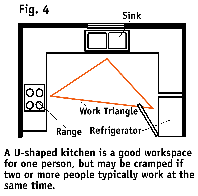
 Cabinets can also be divided into basic
types. Assuming that you're considering modular (pre-manufactured) cabinets rather than
custom, the widths will run in 3" increments from 9" up through 36". The
standard height of a base cabinet is 34 1/2", and the standard depth is 24".
Cabinets can also be divided into basic
types. Assuming that you're considering modular (pre-manufactured) cabinets rather than
custom, the widths will run in 3" increments from 9" up through 36". The
standard height of a base cabinet is 34 1/2", and the standard depth is 24".
 Wall cabinets are 12" deep (except for specialty
cabinets designed to be installed over the refrigerator), and come in the same 3"
increments. Standard heights are 12", 15" 18", 30", and 36". Wall
cabinets are installed so the bottom of the cabinet is 54" above the floor (about
18" above the countertop). The height you select should depend on your ceiling height
and how tall you are - there's no point in buying tall cabinets that reach to the ceiling
if you can't get up to get items in and out of the top shelves.
Wall cabinets are 12" deep (except for specialty
cabinets designed to be installed over the refrigerator), and come in the same 3"
increments. Standard heights are 12", 15" 18", 30", and 36". Wall
cabinets are installed so the bottom of the cabinet is 54" above the floor (about
18" above the countertop). The height you select should depend on your ceiling height
and how tall you are - there's no point in buying tall cabinets that reach to the ceiling
if you can't get up to get items in and out of the top shelves.
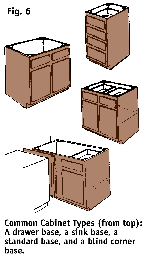
There are four basic types of base cabinets:
Naturally, there are a wide range of variations on these four basic styles (Fig. 6).
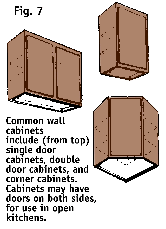 Wall cabinets (Fig. 7) generally have doors and
shelves inside, although lazy susan corner cabinets are also available, as well as a wide
range of specialty cabinets that may offer built-in appliance garages, stemware holders
and other features. Special wall cabinets are also made for microwave and built-in ovens,
range vent hoods and other special uses.
Wall cabinets (Fig. 7) generally have doors and
shelves inside, although lazy susan corner cabinets are also available, as well as a wide
range of specialty cabinets that may offer built-in appliance garages, stemware holders
and other features. Special wall cabinets are also made for microwave and built-in ovens,
range vent hoods and other special uses.