|
Create New Account
Millard Lumber Newsletter
Register to receive newsletters and notices by email. Register Now
|
Installing Hinges
Follow these tips and instructions on how to select and install hinges.
They can help you save time and effort and help you end up with a more satisfactory
job. Inside this document you will find information about:
- Right-hand and Left-hand Hinges
- Installing Hinges
- Selecting the Correct Hinges for the Job
|
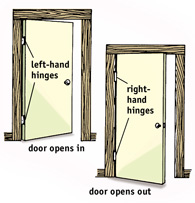
FIG. 1 - You must
select the right type of hinges.
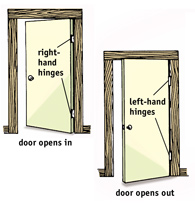
FIG. 2 - On opposite
sides, the doors require different hinges.
|

RIGHT-HAND AND LEFT-HAND HINGES
- Most hinges are reversible, allowing either end to be mounted in an upright
position.
- However, some hinges are made specifically for either a right- or left-hand
door. These cannot be reversed, so you must select the proper hinge.
The question is, how do you know which hinge to use?
- Let's suppose the hinge is a loose-pin hinge (Fig. 3). In this case,
the hinge must be mounted so that the pin can be removed from the top.
Most hinges can have the handing reversed. There are only a few hinges
that cannot have the handing changed. To reverse the handing, remove
the pin and the plug, turn the hinge over but still assembled and replace
the pin in the top and the plug in the bottom. The handing is then reversed.
- In Fig. 1, the doors are mounted on the same side, but one door opens
in while the other door opens out. Even when mounted on the same side,
the door that opens in takes a left-hand hinge while the door that opens
out takes a right-hand reverse hinge.
- In Fig. 2 both doors are mounted on opposite sides, but the door that
opens in requires a right-hand hinge while the door that opens out requires
a left-hand reverse hinge.
- The outside of a door is the corridor side of an interior door and the
outside of an exterior door.
- Stand on the outside of the door. If the door opens into the room
to your right, it requires a right-hand hinge. If it opens into the
room and to your left, it requires a left-hand hinge.
- Be sure to determine which type of hinges you need before beginning the installation.
|
|
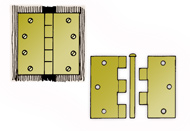
FIG. 3 - Butt and
loose-pin hinges are the most common types used.
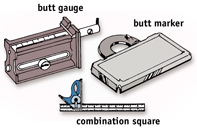
FIG. 4 - Use a combination
square, butt gauge or butt marker to lay out the area to be cut out for
recessed hinges.
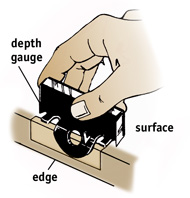
FIG. 5 - Place the
depth gauge on the butt marker against the face of the door or jamb to
mark the thickness of the hinge.
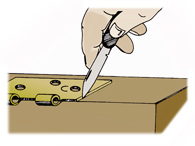
FIG. 6 - Mark the
length on the edge of the door with a pencil, knife or awl.
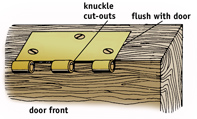
FIG. 7 - The knuckle
cut-outs on the hinge should be flush with the surface of the door.
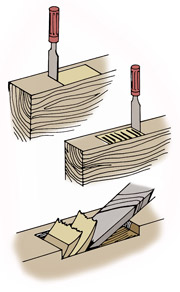
FIG. 8 - Making the
shallow cuts reduces the chances for splitting and makes the wood removal
much easier.
|

INSTALLING HINGES
- Generally speaking, hinges are either surface-mounted or recessed
(mortised). Surface-mounted hinges, as the name implies, are mounted
on the surface of the pieces being hinged. Recessed hinges require the
removal of wood to allow the hinge to be mortised into the wood. Some
hinges are a combination of hinge types. One leaf is surface-mounted
while othe other is mortised or recessed.
- Regardless of the type of hinge you are using, accurate measurements are
a must. Measure all dimensions carefully. If there is any doubt, remeasure.
- Equally important are clearances. Allow for proper clearances between
surfaces, such as the door or lids and frames. These clearances prevent
dragging, binding or a sloppy fit.
- Measurements and clearances make very little difference if you do not follow
through with accurate cutting and drilling. Use the proper tools and
techniques for cutting out recesses. Be sure any holes that are drilled
are accurately centered.
- Two of the most common recessed hinges are the butt hinge (full mortise,
Fig. 3) and the piano hinge. The process of installing all recessed
hinges is basically the same.
- First, determine where the hinges are to be located. For example, a door
hinge is usually 5" from the top and 10" from the bottom of
a door. If you are replacing a door, place the hinges so you can use
the recesses already on the frame, if possible. Or use the same measurements
as found on any other nearby doors.
- If you are doing a single pair of hinges, a combination square works well
for making the necessary layout. If you have more to do, a butt marker
or gauge helps simplify the process (Fig. 4). A different-sized butt
marker is needed for the different-sized hinges. They are not adjustable.
- A hinge is generally recessed by the thickness of the hinge leaf.
A butt marker has a depth gauge built into the handle. Just run it along
the edge of the door or jamb and it makes a cut mark at the proper depth.
The combination square or butt gauge must be adjusted to the proper
thickness. Then run them along the edge as with the marker. You can
use a pencil, but a penknife or scratch awl gives a much sharper line
to follow (Fig. 5).
- The length of the recess is determined by the size of the hinge you
are using. A 3" butt hinge requires a 3" recess. A 36"
piano hinge requires a 36" recess. The easiest way to mark the
length is to place the hinge on the edge of the door in its proper location.
Then mark its length with a pencil, penknife or scratch awl (Fig. 6).
Both the length and the width of a hinge are marked when a butt marker
is placed against the door or jamb and struck with a hammer.
- The width of the recess is also determined by the size of the hinge. A
hinge is generally recessed back far enough so the cutouts in the hinge
for the knuckles are flush with the door or jamb surface (Fig. 7).
- Once these measurements have been transferred to the door, you are
ready to cut the recess. Use a chisel and a wood, plastic or rubber
mallet to score the marked area (Fig. 8). Be sure the chisel is sharp
and is the correct size.
- Next, make shallow cuts as deep as the hinge leaf is thick and about
1/4" apart in the marked area. Tap the chisel lightly for better
control of the cuts.
- Remove the wood you have cut away. A sharp chisel will make this job
go much faster, easier and a lot safer. After you have made the recess
to the proper depth and smoothed it with the chisel, you are ready to
mount the hinge.
- Check the alignment of the hinge in the recess. It must be straight in
order for the hinge to work properly. It must also be recessed deep
enough to allow it to work. If it is too deep, the hinge may pull loose
when it is closed.
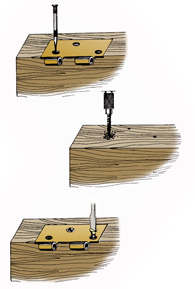
- Put the hinge in place and trace the holes in the hinge onto the wood.
Remove the hinge. Use a center punch to mark the center of each hole.
Using a drill slightly smaller than the body of the screw you will be
using, drill the holes. Replace the hinge and install the screws. Tighten
each screw a little at a time until all the screws are completely tightened
(Fig. 9).
- If the hinge you are using can be taken apart, take it apart prior to assembly. Replace the hinge pin once you are finished. On a door, replace the top pin first. It will help hold the door in place as you replace the lower hinge pins.
|
|
FIG. 9 - The holes
for mounting the hinges must be marked and drilled accurately.

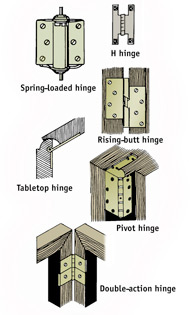
FIG. 10 - Types of
hinges. |

SELECTING THE CORRECT HINGES
FOR THE JOB
- Common butt hinges are most widely used for mounting ordinary doors.
Butt hinges are available in both rigid (fixed-pin) and loose-pin types.
The pin cannot be removed from the rigid or fixed-pin butt hinge while
the pin can easily be tapped out of the loose-pin type with a screwdriver.
- The primary advantage of the loose-pin hinge is that it enables you to
remove the door for any purpose without unscrewing the hinges.
- The loose-joint butt hinge allows you to remove the door by simply lifting
it high enough to make one section of the hinge clear the pin on the
other section. If the door will be removed frequently, you should probably
use the loose-joint hinge.
- The rising-butt hinge is designed for use where shag carpeting or
any other type of thick floor covering might interfere with the opening
of the door.
- The rising-butt hinge allows the door to rise slightly to clear the
carpeting when it is opened.
- The knuckle hinge is primarily a decorative hinge. It carries a considerable
amount of weight and is designed so that only the knuckle of the hinge
shows when the door is closed. It is a loose-joint hinge. You may prefer
this decorative style for some door mountings.
- The butt hinge is primarily used for light doors. This hinge conceals every
part of the hinge except the barrel.
- The ball-bearing hinge is a bit more expensive, but you may find it desirable
for certain heavy-duty door mountings.
- The ball-bearing hinge is permanently lubricated and is primarily designed
for use on heavy exterior doors. It can be used, however, on any door
that might get unusually heavy use.
- The double-acting hinge is used mostly on cafe doors. The double-acting
hinge permits the door to open in either direction.
- Use the pivot hinge for overlay doors, recessed doors or flush doors.
- You can purchase the gravity pilot hinge with or without a hold-open stop.
- The offset blind hinge is used almost exclusively on screen or storm doors.
The design permits a swing-away of the storm or screen door without
interference from the hinges.
- The spring-loaded hinge has a built-in spring mechanism that closes the
door after it's opened. Some spring-loaded hinges have adjustable tension
features that permit you to tighten or loosen the hinge as you would
an ordinary door closer.
- The back flap hinge is a version of the butt hinge, but is somewhat smaller.
It is primarily a furniture-type hinge and is not widely used on general
construction.
- Use the tabletop hinge for any construction where one leaf in a section
of wood needs to be dropped, somewhat like a tabletop.
- Use ornamental hinges on cabinetwork and some types of furniture.
- The rustic semi-concealed hinge is available in many colors and designs.
The semi-concealed feature of the hinge gives the exposed portion a
neat appearance.
- The H and HL hinges are also rustic-type hinges used on light cabinetwork
where appearance is extremely important. Be sure to match all other
cabinet hardware to the same appearance and design as the H or HL hinges.
- Strap hinges, T hinges and continuous hinges are special types of
hinges used only on certain projects.
- Strap and T hinges are available in many sizes. They are used primarily
for heavy, rough-type installations.
- The continuous hinge is also called a piano hinge. It is used primarily
on lids of chests, cabinets and similar places. Continuous hinges are
available in many sizes and finishes.
|
Check your state and local codes before starting any project.
Follow all safety precautions. Information in this document has been furnished
by the National Retail Hardware Association (NRHA) and associated contributors.
Every effort has been made to ensure accuracy and safety. Neither NRHA, any contributor
nor the retailer can be held responsible for damages or injuries resulting from
the use of the information in this document.
|